
Why Do Some Sites Need Vehicle Access Control?
Sensitive facilities, private entrances, temporary projects, and restricted areas may require reliable systems for controlling vehicle access.
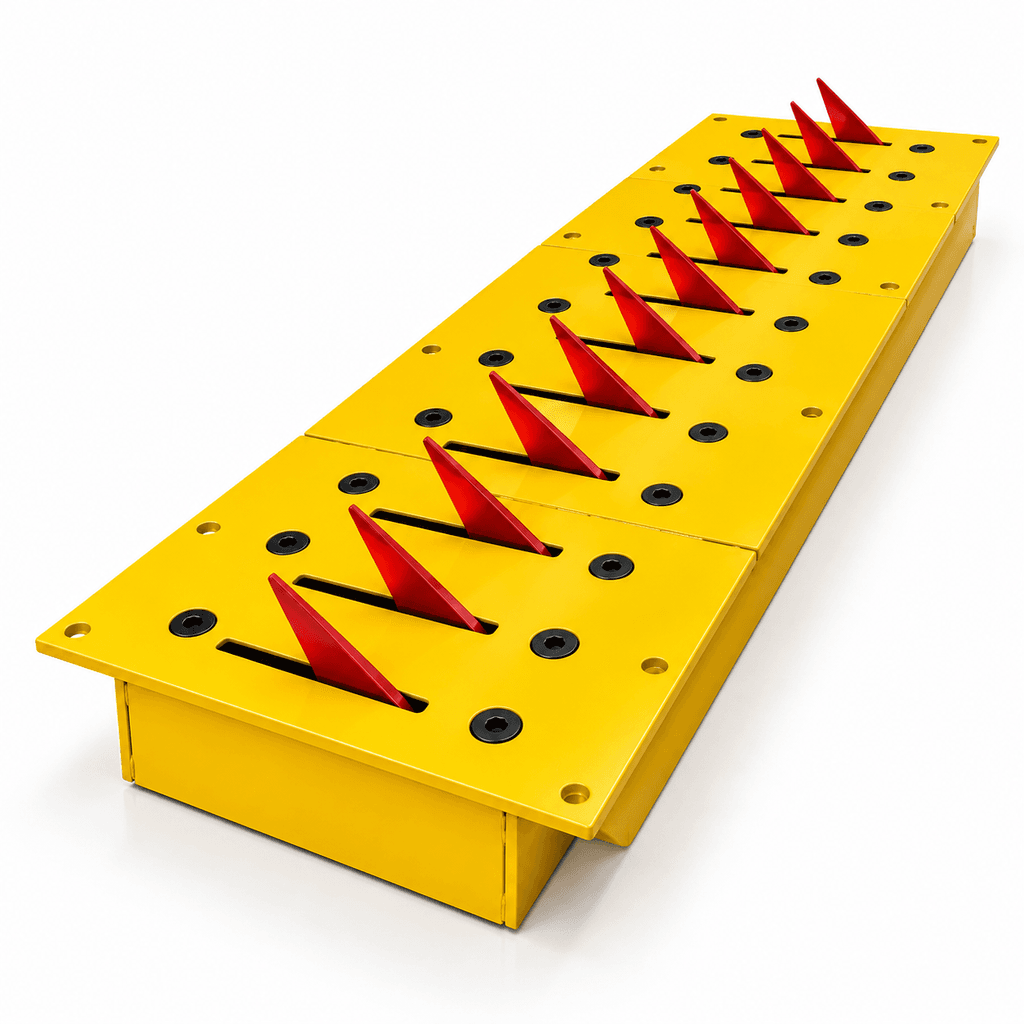
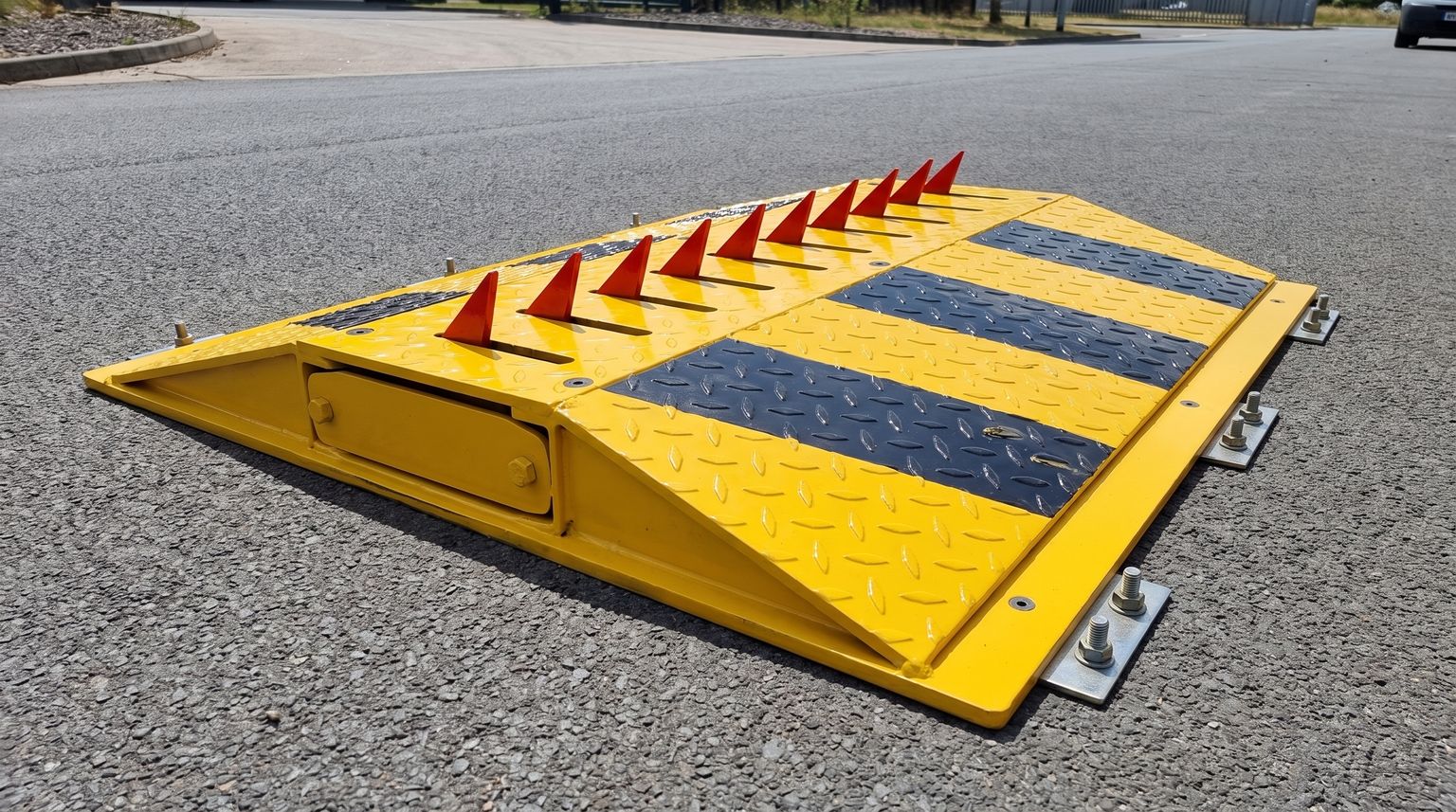
- Above-ground vehicle barriers include the above-ground tyre killer, bolted onto asphalt or concrete with no excavation.
- Vehicles pass in the permitted direction over anti-slip ramps, while its 150–200 mm steel spikes are designed to puncture the tyres of a vehicle coming the wrong way.
- It stands 100–120 mm above the road and carries 50 tonnes per axle, according to the catalogue.
The right solution depends not only on the required level of access control but also on the site's existing infrastructure. Deep excavation may not be practical in areas containing underground utilities, pipes, cables, or other infrastructure.
This is where surface-mounted vehicle control systems can provide a practical alternative.
What Are Surface-Mounted Vehicle Barriers?
Surface-mounted barriers are installed directly onto an existing asphalt or concrete surface without requiring extensive excavation or complex underground foundations.
Depending on their design, these systems can help organize vehicle movement and restrict unauthorized access at controlled entry points.
When Is Surface Installation Useful?
Surface-mounted systems can be particularly useful when deep excavation is undesirable or difficult, including:
- Areas with underground utilities.
- Temporary entrances and construction sites.
- Facilities requiring relatively fast installation.
- Locations where major ground modifications are impractical.
- Sites where the access-control system may need to be relocated or modified later.
Why Does the Road Surface Matter?
The installation surface affects how a vehicle control system is secured and how it performs over time.
The system should be compatible with the existing surface, whether asphalt or concrete, while installation requirements should account for traffic conditions, environmental exposure, and expected usage.
How Do Vehicle Access Control Systems Work?
Different systems use different operating mechanisms. Some incorporate movable or deployable metal elements that control vehicle passage when activated.
When combined with gates, access-control systems, warning signs, and other traffic-management measures, they can create a more organized vehicle entry point.
Where Can These Systems Be Used?
Vehicle access control solutions can be used in a range of locations, including:
- Industrial facilities.
- Warehouses and logistics centers.
- Private entrances.
- Restricted vehicle-access areas.
- Temporary project sites.
- Facilities requiring controlled vehicle movement without major construction work.
What Should You Consider Before Choosing a System?
Several factors should be evaluated before selecting a vehicle access control solution.
These include vehicle type, traffic volume, road surface, available installation space, operating method, maintenance requirements, and the level of access control required.
Sites with both vehicle and pedestrian traffic should also consider appropriate warning systems and safe operating procedures.
Why Consider Surface-Mounted Solutions?
When deep excavation is not suitable, surface-mounted systems can provide an alternative method for installing vehicle access control equipment while minimizing major ground work.
The appropriate solution ultimately depends on the site's infrastructure, traffic requirements, installation conditions, and the technical specifications of the selected system.
SAB TECH above-ground tyre killer: key specifications
These are the main specifications of the above-ground tyre killer supplied by Bestolex:
| Specification | Value |
|---|---|
| Surface Ramp Height | 100 – 120 mm above ground |
| Spike Projection Height | 150 – 200 mm |
| Total Barrier Length | 2000 – 6000 mm |
| Steel Plate Thickness | 10 – 12 mm |
| Max Axle Load | 50 Tons per axle |
| Installation Method | Direct surface mount via heavy-duty expansion bolts |
| Drive System | Electromechanical hydraulic or mechanical counterweight |
| Operating Temp | -20°C to +65°C |
Source: SAB TECH catalogue approved by Bestolex; full details on the product page.
Conclusion
Vehicle access control is not limited to conventional gates and barriers. Different solutions can be selected according to the site's infrastructure, traffic conditions, and operational requirements.
For locations where deep excavation is impractical, surface-mounted vehicle control systems can offer a practical installation approach, particularly for temporary sites and areas with underground infrastructure.
Above-ground vehicle barriers in Qatar
In Qatar, vehicle direction-control barriers are typically specified at government gates, critical facilities, ports, industrial sites and commercial complexes, and the consultant often sets the entrance requirements in the project specification. So Bestolex starts with a survey of the entrance: road width, vehicle types and traffic, buried services, and how the system ties into access control. Surface fixing suits car park exits and entrances with buried services, because no excavation is needed.
What to prepare before asking for a quote
- The entrance width, number of lanes and photos
- Vehicle types and weights, and traffic per hour
- Whether the project specification requires an anti-ram rating, and to which standard
- How it should link to access control (cards, remote control, number plate recognition)
- A drawing of buried services, if available
Bestolex is the exclusive SAB TECH agent in Qatar and handles the site survey, supply, installation, commissioning, operator training, maintenance and spare parts. Browse the full range under perimeter protection, or read how tyre killers protect facility entrances in our tyre killer article. To discuss your site, request a site survey or a quotation, or message us on WhatsApp at +974 51505014.