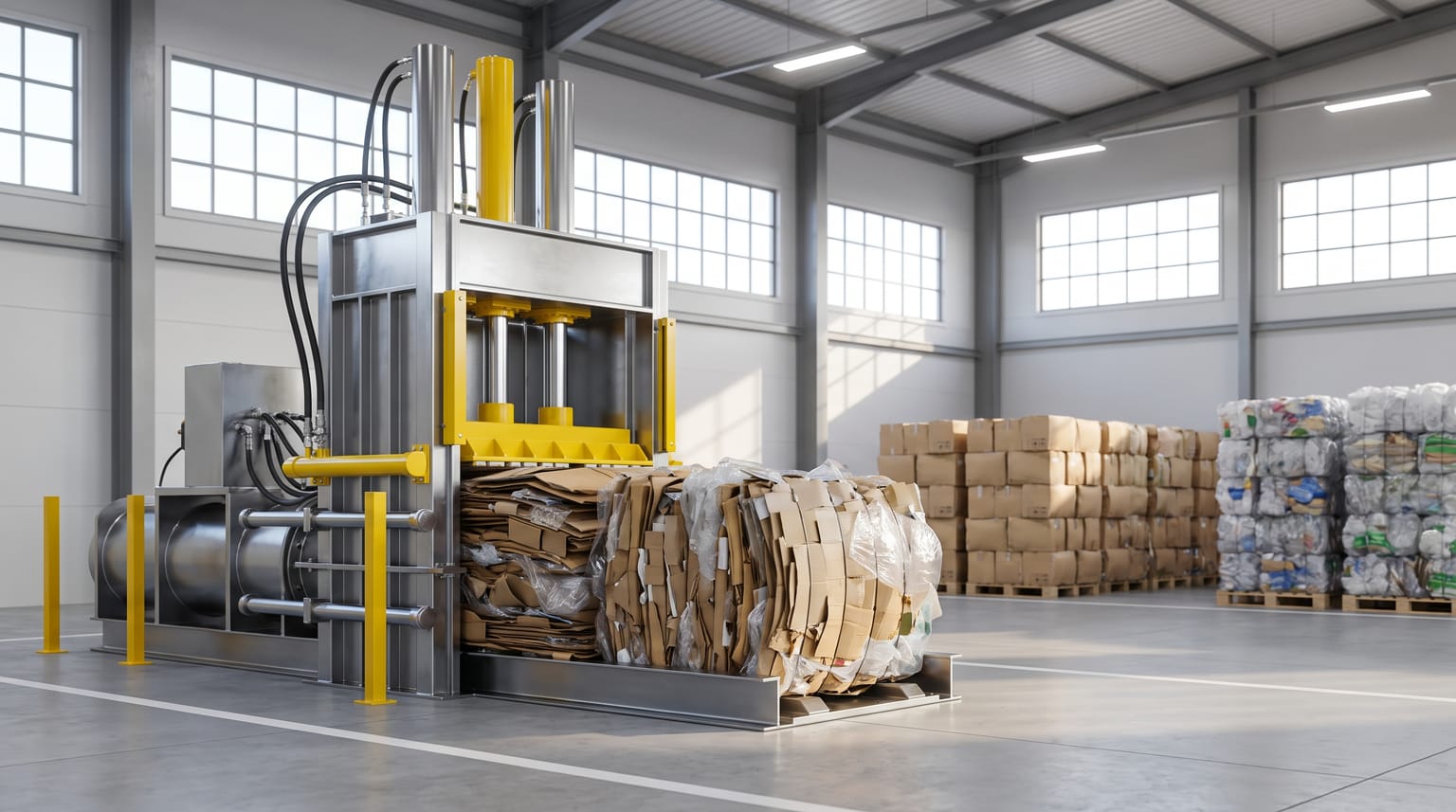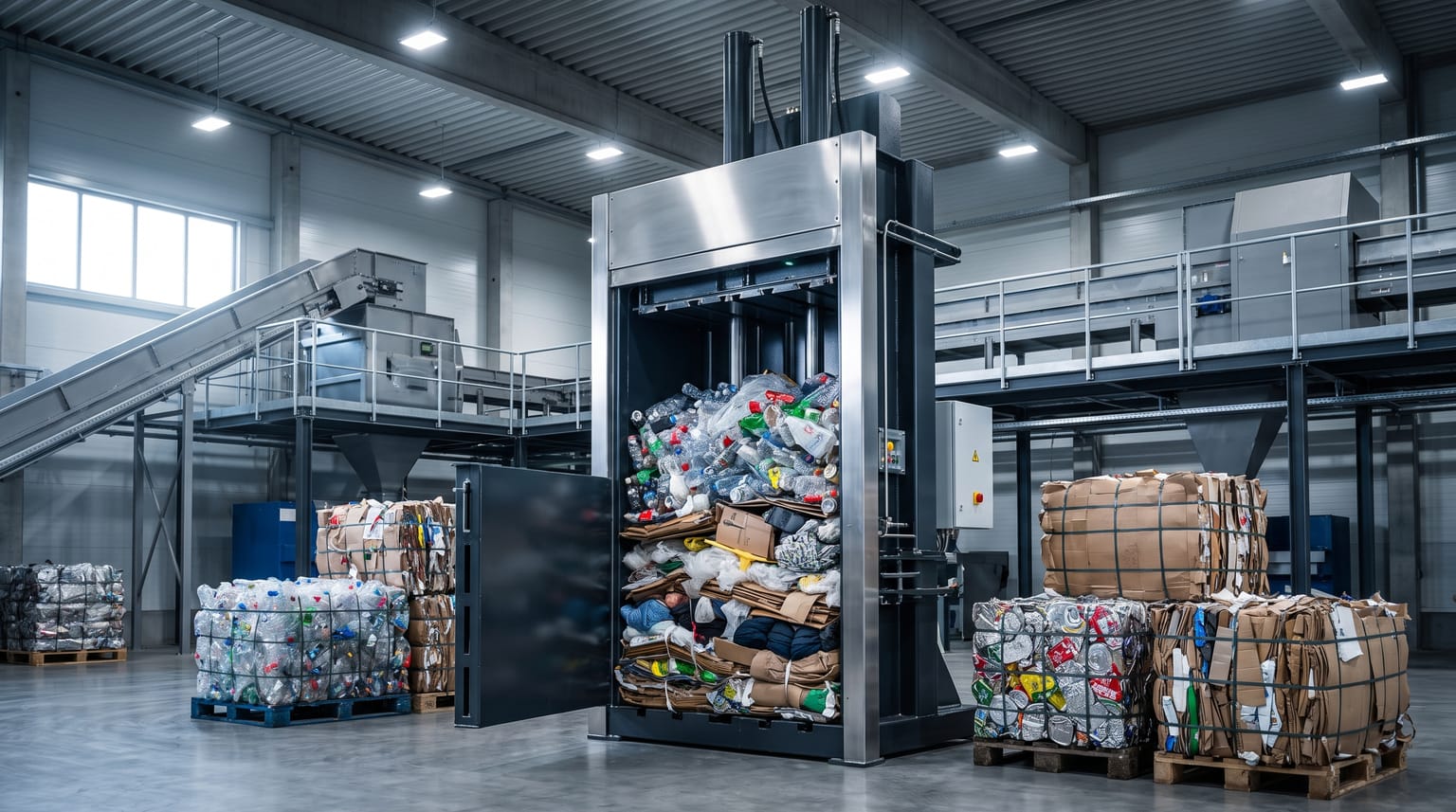

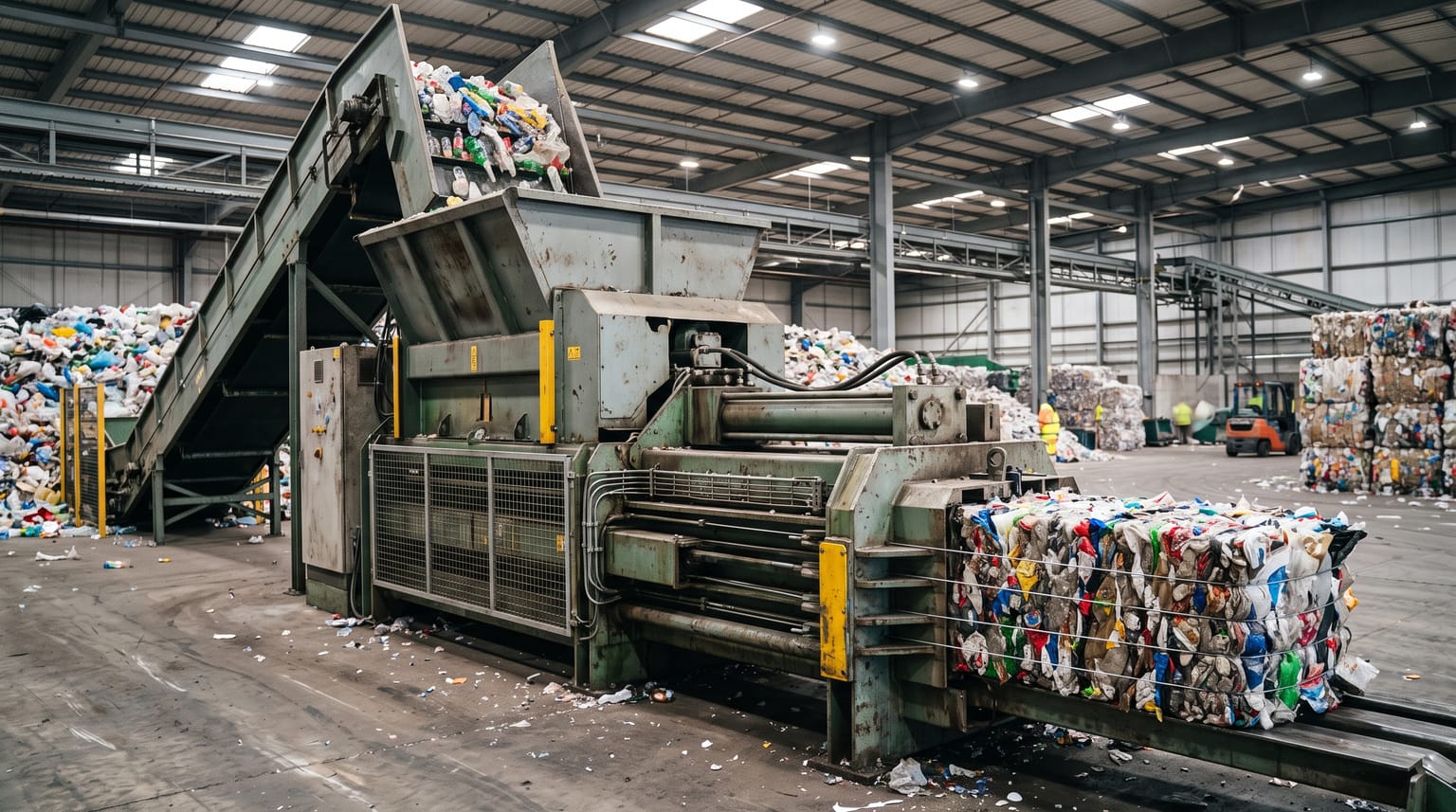
By compressing loose plastic materials into dense, stable bales, facilities can improve material handling, storage efficiency and transportation. Balers condense recyclables into manageable, stackable units, and reducing the volume makes the material easier to market and cheaper to transport.
- Baling turns light, bulky plastic into dense bales that are easier to store, haul and sell to recycling plants.
- Baling comes before recycling and does not replace sorting: clean, sorted plastic makes a more valuable bale.
- Horizontal balers suit large, continuous volumes; vertical balers suit smaller volumes and tight spaces.
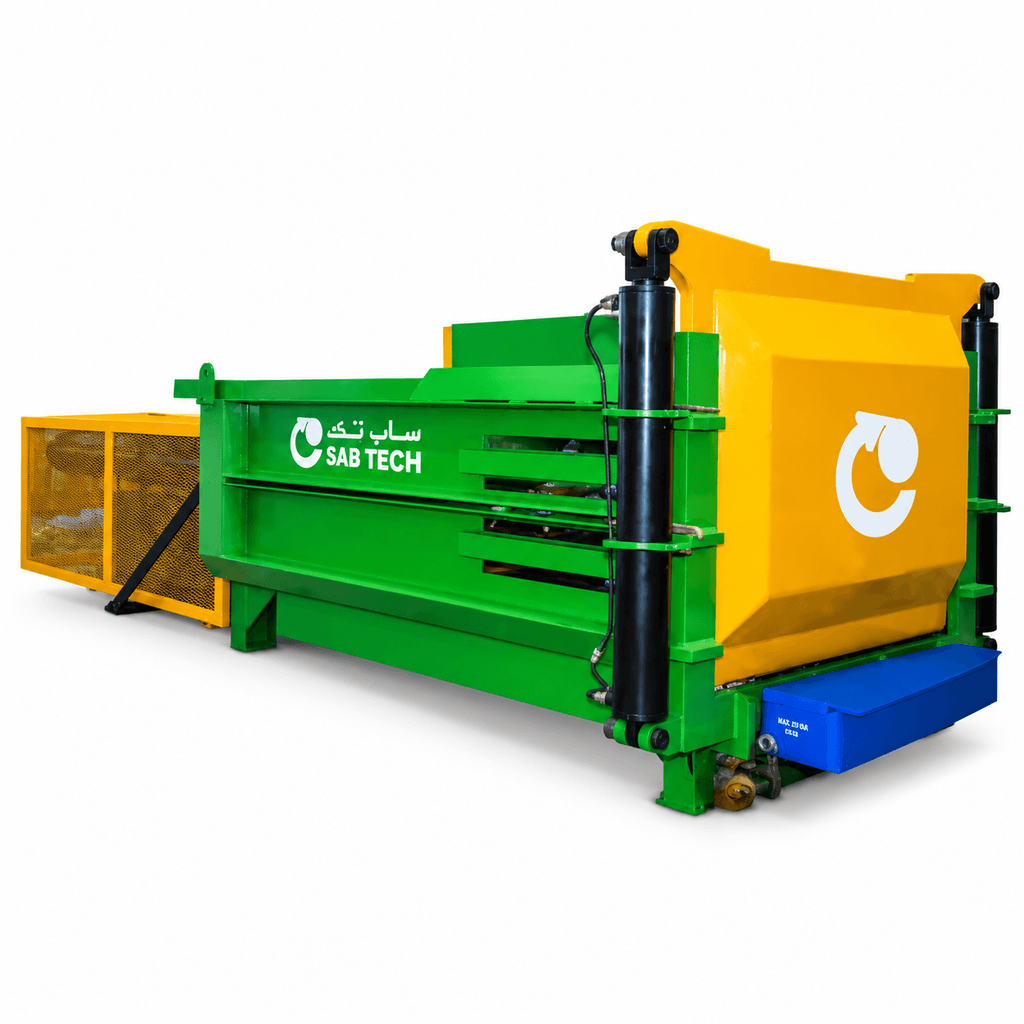
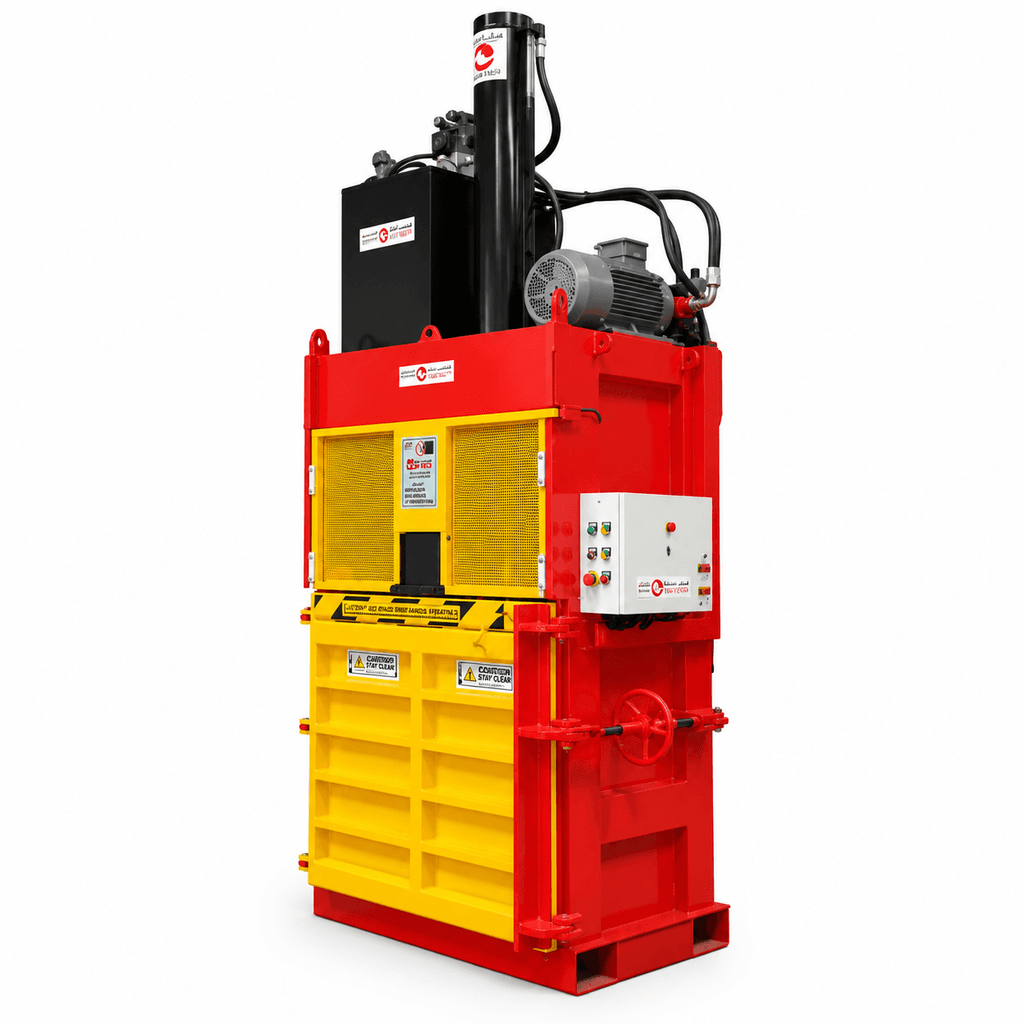
- In the Bestolex catalogue: a 70-ton horizontal press, a 22–45 ton horizontal auto baler with automatic tying, and vertical balers from 10 to 80 tons.
What Is Plastic Waste Baling?
Plastic waste baling is a mechanical process used to compress loose plastic materials into compact bundles or bales.
The objective is not to recycle the plastic chemically or mechanically at this stage. Instead, the process changes the physical form and bulk density of the material, making it easier to handle, store and transport.
Depending on the equipment and material stream, baling can be applied to plastic bottles, packaging materials, films, industrial plastic waste and other recyclable plastic streams.
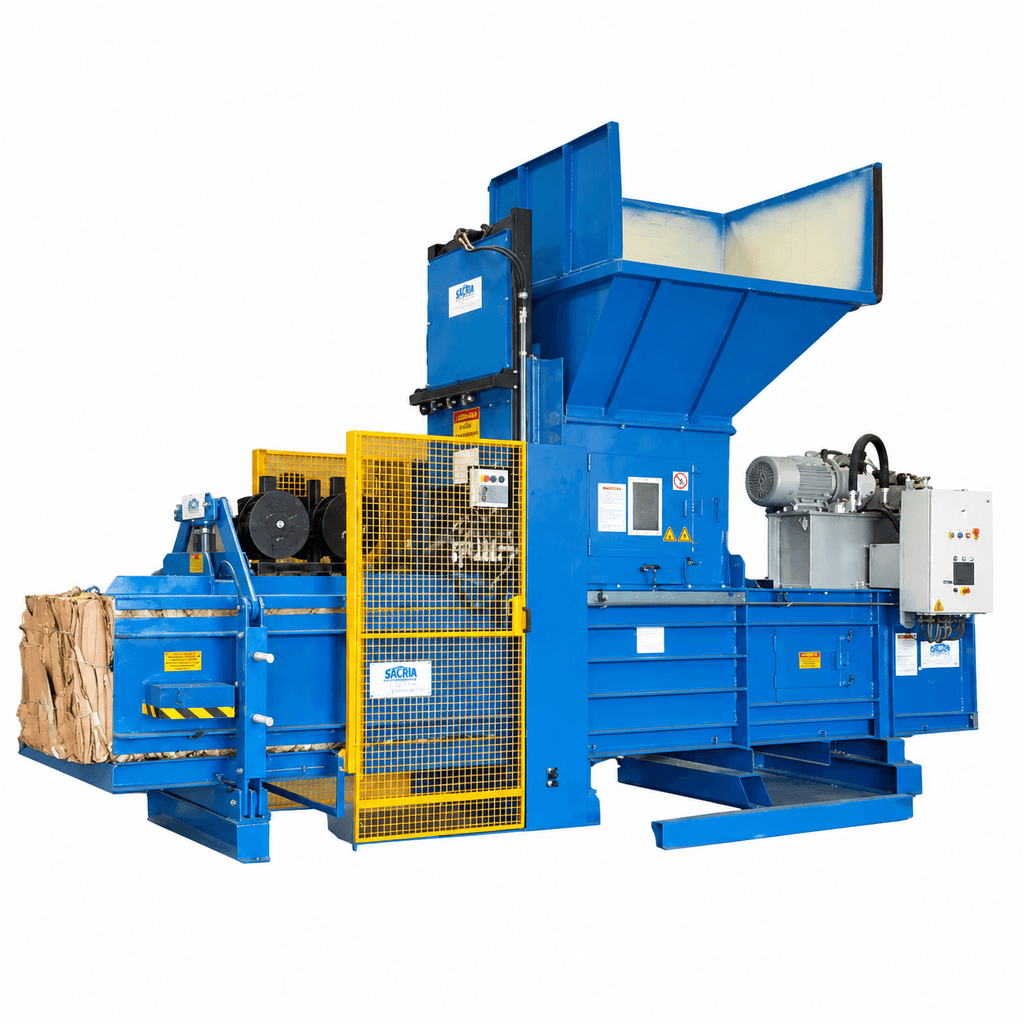
A modern industrial baler may combine a feeding system, hydraulic compression mechanism, bale chamber, control system and automatic tying mechanism.
Why Does Plastic Waste Need to Be Compressed?
Many plastic materials have a relatively low bulk density. Empty bottles, packaging films and other lightweight plastic products can occupy large volumes before they are processed.
This creates several operational challenges:
High storage-space requirements.
Inefficient internal handling.
Difficult stacking.
Low transport efficiency.
Increased handling frequency.
Higher logistics costs in volume-limited transportation.
Poor organization of recyclable material streams.
Compaction addresses the volume problem by converting loose material into denser and more manageable units.
How Does a Hydraulic Plastic Baler Work?
A hydraulic horizontal baler uses hydraulic power to generate compression force through one or more hydraulic cylinders and rams.
The general operating sequence can include:
Material Collection
Plastic waste is collected from commercial, industrial or recycling operations.
Sorting
Material may be sorted by polymer type, color, product type, contamination level or recycling destination.
This is particularly important because plastic is not a single material. PET, HDPE, LDPE, PP and other polymers have different properties and recycling pathways.
Collection and sorting are fundamental stages of effective plastic recycling; in mechanical recycling they are followed by shredding, washing, further sorting and extrusion.
Feeding
Prepared material is introduced into the baler's hopper or feed opening.
In high-throughput facilities, conveyors or automated feeding systems can be integrated into the process.
Hydraulic Compression
The hydraulic ram applies substantial force to compress the material inside the baling chamber.
Bale Formation
Repeated or continuous compression produces a denser mass with a defined bale shape.
Bale Tying
The compressed material is secured using a tying system so that the bale remains stable during storage and transportation.
Modern horizontal balers can incorporate automatic tying systems, reducing manual intervention and improving throughput.
Horizontal vs. Vertical Balers
The choice between a horizontal baler and a vertical baler depends on the material stream, volume, available space, required throughput and level of automation.
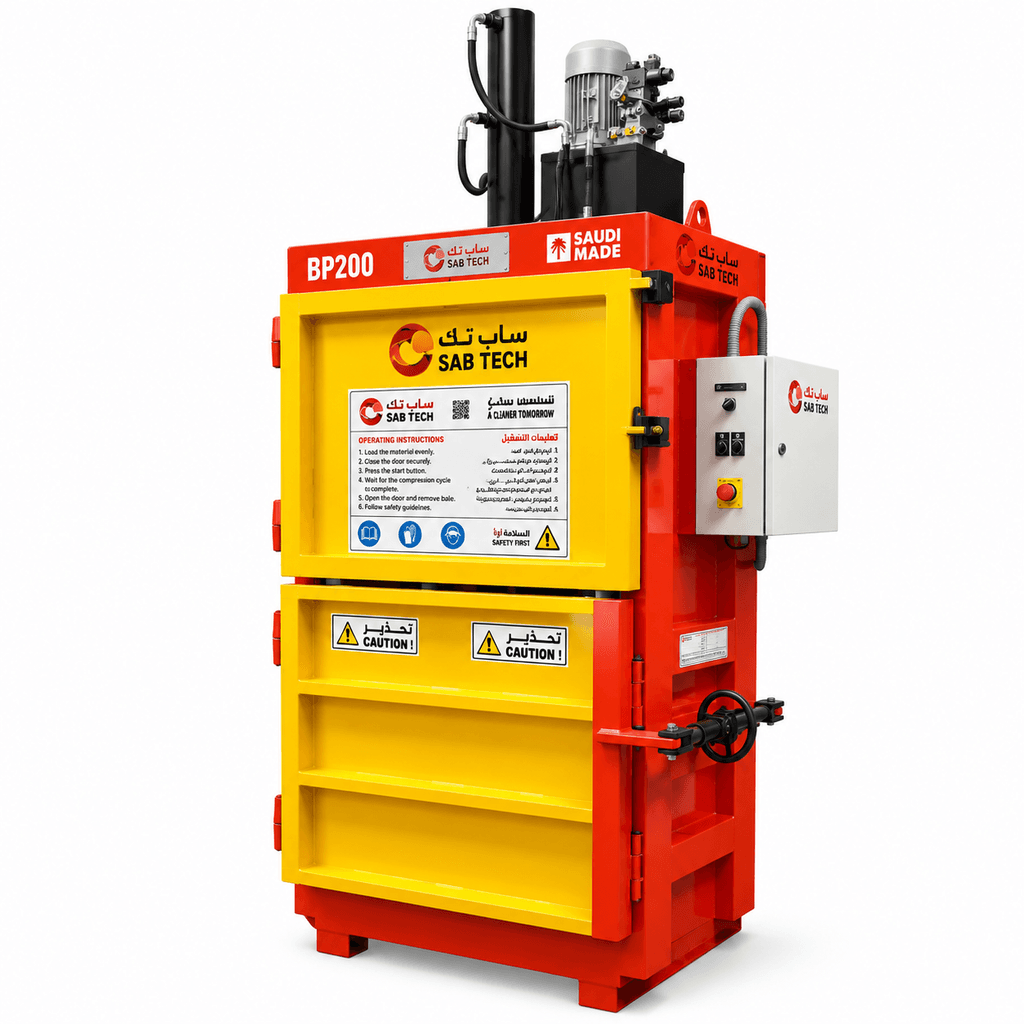
Vertical balers can be useful for smaller or moderate material volumes and generally require less floor space.
Horizontal balers are commonly associated with higher-volume applications and can be configured with automated feeding and tying systems.
Horizontal balers generally offer greater capacity than vertical balers, but they cost more and need more floor space.
Therefore, the question is not simply which machine is better. The correct question is:
Which baler configuration matches the facility's material stream and operating requirements?
What Types of Plastic Can Be Baled?
The suitable material depends on the baler's design and the recycling process receiving the material.
Potential applications can include:
PET bottles.
HDPE containers.
Plastic packaging.
Plastic films.
Commercial plastic waste.
Industrial plastic waste.
Manufacturing residues.
Selected mixed plastic streams.
Material separation remains important because different polymers can have different recycling processes and market values.
PET and HDPE are among the plastics most commonly recycled mechanically.
Baling Is Not the Same as Recycling
An important distinction must be made between baling and recycling.
A baler does not turn plastic waste into new plastic.
Instead, it prepares the material for subsequent stages of the recycling chain.
A simplified process can look like this:
Collection → Sorting → Preparation → Baling → Storage and Transportation → Recycling → Processing → Recycled Material
Baling therefore acts as a logistical and material-handling stage within the broader recycling system.
This distinction is particularly important when evaluating waste-management equipment because the baler's purpose is to improve the physical handling of recyclable materials rather than replace sorting, washing, shredding or extrusion equipment.
How Does Baling Improve Transportation Efficiency?
Transportation efficiency is strongly influenced by bulk density.
Loose plastic can fill a truck or container by volume long before the vehicle reaches a practical payload by weight.
Compressing the material increases the amount of material that can be organized within a given volume.
Depending on the operation, this can help:
Reduce storage volume.
Improve load organization.
Reduce handling requirements.
Improve vehicle space utilization.
Reduce transportation frequency in some applications.
Simplify shipment to recycling facilities.
The actual financial benefit depends on material density, transportation distance, vehicle capacity, bale dimensions and operating conditions.
Why Is Bale Density Important?
Bale density is one of the most important performance considerations in a baling operation.
It can be affected by:
Plastic type.
Material shape.
Material moisture.
Contamination.
Feeding method.
Compression force.
Bale-chamber design.
Compression cycle.
Tying method.
Material preparation.
For this reason, comparing balers only by hydraulic pressure or nominal compression force does not provide a complete picture of performance.
A better evaluation considers the complete operating system, including throughput, bale dimensions, achievable density, cycle time, feeding system and tying system.
The Role of Automatic Bale Tying
In low-volume operations, manual bale tying may be acceptable.
However, when material volumes increase, tying can become a major bottleneck.
An automatic bale tying system can reduce manual intervention and help maintain a more continuous production process.
This becomes particularly useful in:
Large recycling centers.
Distribution centers.
Warehouses.
Logistics facilities.
Manufacturing plants.
Supermarkets.
Shopping centers.
Municipal recycling operations.
Sites with large volumes of recyclables often need a baler with continuous feeding and automatic tying.
Applications of Plastic Balers
Supermarkets
Supermarkets generate significant amounts of packaging and recyclable material. Baling can help organize these materials and reduce the space required before collection.
Shopping Centers
Shopping centers may generate recyclable materials from multiple retail and service operations, creating a need for organized collection, sorting and compaction.
Warehouses and Logistics Centers
Large distribution operations often generate substantial quantities of packaging materials. Compaction can become part of the facility's internal material-flow strategy.
Manufacturing Facilities
Manufacturing processes may produce consistent streams of plastic scrap and packaging waste, making sorting and baling easier to standardize.
Printing and Graphics Industries
Depending on the operation, printing and graphics facilities can generate packaging and plastic-related production waste that may be suitable for dedicated recycling streams.
Recycling Companies
Large recycling facilities are among the most obvious applications for high-capacity horizontal balers because they process significant volumes of recyclable material.
Municipal Operations
Municipal recycling systems can also use baling equipment as part of their collection, sorting and material preparation processes.
Can Baling Increase the Economic Value of Plastic?
Baling can improve the logistical value of recyclable material, but it does not automatically increase the market value of the polymer itself.
A well-formed bale can be:
Easier to store.
Easier to weigh.
Easier to handle.
Easier to load.
Easier to transport.
More consistent for downstream buyers.
However, the actual market value of recycled plastic depends on polymer type, purity, contamination, bale quality, market demand and buyer specifications.
Good economic results therefore come from an integrated system:
Good collection + accurate sorting + material quality + efficient baling + proper storage + optimized transportation + reliable recycling demand.
How to Choose a Plastic Baler
Selecting a plastic baling machine should begin with the material stream rather than the machine name.
Important factors include:
Material Type
What material will be baled?
PET bottles, HDPE containers, plastic film, packaging waste and industrial scrap can behave differently during compression.
Material Volume
Determine actual daily and weekly quantities instead of relying on general estimates.
Required Throughput
The baler must be able to handle the facility's actual material flow without becoming a production bottleneck.
Bale Dimensions
Bale size affects storage, forklift handling, transportation and downstream processing.
Bale Density
The required density depends on the material and the intended use of the bales.
Feeding System
Feeding may be manual, hopper-based, conveyor-fed or integrated into an automated material-handling system.
Tying System
The operation may require manual, semi-automatic or fully automatic bale tying.
Available Space
Horizontal balers require sufficient space for the machine, feeding area, bale discharge, handling equipment and maintenance access.
Hydraulic System
The hydraulic system, cylinders, hoses, valves and controls should be evaluated for reliability, serviceability and compatibility with the intended duty cycle.
Why Are Horizontal Balers Suitable for High-Volume Operations?
As material volumes increase, throughput and automation become increasingly important.
Horizontal balers can be integrated into larger recycling systems and may support continuous or semi-continuous material feeding, automated tying and downstream bale handling.
This makes them particularly suitable for operations where processing each bale manually would limit productivity.
However, machine selection should always be based on the actual material flow, required throughput and facility layout rather than simply choosing the largest available baler.
Safety Considerations for Plastic Baling Equipment
Baling equipment uses high compression forces, moving mechanical components and hydraulic systems. Safety must therefore be considered during operation, cleaning, maintenance and troubleshooting.
The main hazards are crushing, moving parts, unexpected start-up and the discharge door, so training and energy-isolation procedures during maintenance are essential.
One of the most important principles is:
Never enter a baling chamber or hazardous machine area while the equipment can move or contains uncontrolled energy.
During maintenance, cleaning, jam removal or repair, appropriate Lockout/Tagout (LOTO) procedures must be followed.
This means identifying and isolating every energy source, safely releasing stored or residual energy, and verifying isolation before work begins.
The structural condition of critical components should also be inspected periodically, especially components exposed to repeated high loads such as discharge-door locking mechanisms on applicable hydraulic balers.
Maintenance of Plastic Baling Machines
Preventive maintenance helps reduce unexpected downtime and preserve machine performance.
Depending on the machine design and manufacturer requirements, maintenance may include:
Hydraulic-system inspection.
Leak detection.
Hose and fitting inspection.
Hydraulic-cylinder inspection.
Ram and chamber inspection.
Tying-system inspection.
Feed-area cleaning.
Sensor inspection.
Control-system inspection.
Discharge-door inspection.
Safety-guard inspection.
Locking-mechanism inspection.
Monitoring unusual noise or vibration.
The manufacturer's maintenance instructions should always take priority because baler designs, operating loads and safety systems vary between machines.
Plastic Baling and the Circular Economy
Plastic recycling is part of a broader transition toward a circular economy in which materials are kept in productive use for as long as possible.
For plastics, the process begins with collection and sorting and can continue through mechanical or other recycling technologies.
From this perspective, plastic waste baling is part of the logistics infrastructure that moves sorted recyclable materials from collection points toward recycling facilities.
The baler does not complete the recycling process, but it can make the material significantly easier to store, handle and transport.
Plastic balers in the Bestolex catalogue compared
| Specification | Horizontal baling press 70T | Horizontal auto baler | Vertical baler 20T |
|---|---|---|---|
| Pressing force | 70 tons | 22 – 45 tons | 20 tons |
| Bale weight | Up to 300 kg | 300 – 400 kg | Up to 200 kg |
| Motor power | 22 kW | 7.5 – 15 kW | 5.5 kW |
| Tying | Manual | Fully automatic, 3 – 4 wires | 3 binding slots |
| Suits | Large volumes of cardboard, plastic and PET | Continuous running with little manual input | Shops and warehouses with smaller volumes |
Source: Bestolex approved product catalogue. Bale weight varies with the material. The "Suits" row is general guidance.
The Horizontal Auto Baler: A Practical Option for Large Volumes
For facilities handling substantial quantities of plastic waste and recyclable materials, a fully automatic horizontal hydraulic plastic baler with automatic bale tying can provide a practical method for compressing material into stable, manageable bales.
Depending on the machine configuration and material stream, applications can include:
Shopping centers.
Supermarkets.
Large retail stores.
Manufacturing industries.
Printing and graphics operations.
Warehouses.
Logistics centers.
Large-scale recycling companies.
Selected municipal applications.
Its main advantage is that it can form part of an integrated material-handling system, from feeding to tied bales ready for handling and transport, without repeated manual work.
How Should a Facility Determine the Right Baler?
There is no single baler that is ideal for every facility.
A proper equipment evaluation should start with:
Material type → Daily volume → Material flow → Sorting quality → Available space → Required bale size → Transportation method → Automation level → Tying requirements → Maintenance and safety requirements.
This information makes it possible to determine whether the facility needs a vertical or horizontal baler, batch or continuous operation, manual or automatic tying, and what level of hydraulic capacity is appropriate.
Plastic baling and recycling in Qatar
According to Qatar News Agency, Qatar's national environment and climate strategy aims to close and rehabilitate unsanitary landfills and reach a 15% material recycling rate for municipal waste. Separating plastic and cardboard at source and baling them is a practical first step for commercial and industrial sites.
Bestolex, the exclusive SAB TECH agent in Qatar, supplies the horizontal baling press 70T, the horizontal auto baler and the 80-ton vertical baler for bottles and cans, with the full range under Waste & Recycling. We handle the site survey, supply, installation, training, maintenance and spare parts.
Conclusion
Plastic waste baling is an important part of modern recyclable-material management because it can reduce bulk volume and improve storage, handling and transportation efficiency.
The technology becomes especially valuable when facilities handle large quantities of lightweight plastic packaging, containers, films and industrial or commercial plastic waste.
Horizontal hydraulic automatic balers can provide a practical solution for high-throughput applications where continuous material flow, automatic tying and reduced manual handling are important.
However, efficient plastic recycling does not depend on the baler alone. The overall performance of the system depends on collection, sorting, material quality, contamination control, storage, transportation and downstream recycling capabilities.
The horizontal plastic baler should therefore be viewed as one component of a larger recycling infrastructure designed to transform loose, bulky recyclable materials into organized and compact bales that can move efficiently through the recycling supply chain.
Does your site produce large amounts of plastic or cardboard? Request a site survey or a quotation, or message us on WhatsApp at +974 51505014.